China-Germany Scientists Build Floating Magnet To Detect Signals
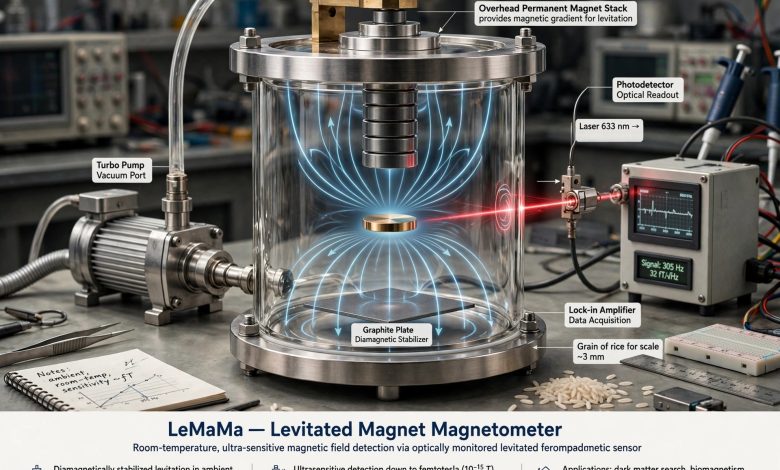
Scientists from Peking University in China and Johannes Gutenberg University Mainz in Germany have built the world’s first room-temperature ultra-precise magnetometer that uses a levitated magnet to detect ultra-weak signals a billion times fainter than Earth’s field. The device called LeMaMa was published in the journal Science on August 6 2026 and operates without cryogenic cooling inside a glass vacuum chamber.
According to http://Phys.org, the breakthrough eliminates the need for expensive SQUID magnetometers that require liquid helium at near absolute zero and bulky shielded rooms. LeMaMa works like a floating compass with a permanent magnetic disk smaller than a grain of rice levitating in mid-air with virtually no friction. An overhead stack of magnets pulls the disk upward against gravity while a graphite plate beneath provides repulsive force to stabilize it. A 633 nm laser tracks tiny deflections via photodetector optical readout to measure femtotesla fields at 32 femtotesla per root hertz sensitivity.
The team said measuring ultra-faint magnetic fields is crucial for mapping brain activity, monitoring hearts and probing fundamental physics. The combination of room temperature operation, tiny components and high sensitivity makes LeMaMa promising for fundamental physics experiments said Ji Wei assistant professor at Peking University School of Physics and corresponding author of the study. Researchers noted signal at 305 Hz resonance confirms stable levitation under ambient conditions.
The evergreen explainer is that magnetic field strength is measured in tesla with hospital MRI at 1.5 tesla and human brain activity at femtotesla which is one quadrillionth of a tesla. Similar to how WASSCE grading standardizes academic assessment, CSSPS manages school placement and Energy Commission licensing regulates electrical devices in Ghana, magnetometer calibration follows strict protocols under the International System of Units. Room temperature operation removes cost barriers that previously limited sensitive magnetometry to advanced labs, opening opportunities for Ghanaian universities and teaching hospitals to adopt portable brain scanners.
The device has two immediate frontiers. In physics it widens the hunt for elusive dark matter particles that may interact via faint magnetic signatures. In medicine it enables affordable portable magnetoencephalography and magnetocardiography without cryogenics. The table top sensor operates under ambient conditions and signals a shift toward diamagnetically stabilized levitation as a platform for precision measurement and fundamental research.
Source: #Howedey.com
Call or WhatsApp +233 20 2190 250 and share your story.
Author: Korkor Anumu