Earth More Exposed to Solar Storms Than Thought
New research suggests the most powerful solar storms could disrupt Earth twice as severely as previously believed.
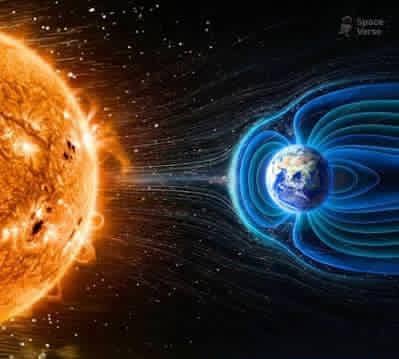
Scientists have warned that Earth may be significantly more vulnerable to the effects of extreme solar storms than previously believed, with new research suggesting the planet’s response to the most powerful solar events could be nearly twice as intense as earlier scientific models predicted. The findings challenge a long-standing assumption that Earth’s magnetic field reaches a protective upper limit when struck by exceptionally strong solar wind. Instead, researchers say the planet’s geomagnetic response may continue to intensify as solar conditions become more extreme, potentially increasing the risks posed to modern technological infrastructure.
The study, published in the journal Nature, was led by Dr. Nithin Sivadas of NASA’s Goddard Space Flight Center in collaboration with Dr. Maria Walach of Lancaster University. Researchers say the discovery has important implications for forecasting space weather and assessing the resilience of critical infrastructure, including satellites, global positioning systems (GPS), radio communications, aviation operations and electricity transmission networks.
Space weather originates from activity on the Sun, where the continuous stream of electrically charged particles known as the solar wind travels through the solar system and interacts with Earth’s magnetic field. During periods of intense solar activity, powerful eruptions can dramatically strengthen this flow, sending massive bursts of energy toward Earth. When these particles collide with Earth’s magnetosphere, they generate strong electric currents in the planet’s upper atmosphere. While these interactions often produce spectacular auroras, they can also interfere with satellite operations, disrupt navigation and communication systems, increase radiation exposure for astronauts and high-altitude flights, and induce damaging electrical currents in power grids.
Dr. Walach noted that Earth’s magnetic field generally provides strong protection against the effects of space weather, with most disturbances causing only minor technological glitches or colourful auroral displays. However, she cautioned that severe solar storms can produce far more serious consequences, including satellite failures, communication blackouts and GPS disruptions. For decades, scientists believed there was a natural limit to how strongly Earth’s upper atmosphere could respond to increasingly powerful solar wind. Observations appeared to show that atmospheric electric currents eventually stopped increasing proportionally, leading researchers to conclude that the magnetosphere restricted the amount of energy entering the atmosphere during extreme events.
The new study argues that this apparent ceiling is likely not a physical phenomenon but rather the result of statistical uncertainty in the measurements used to study solar wind. Scientists explained that solar wind conditions are typically measured by spacecraft positioned near the first Lagrange point (L1), approximately 1.6 million kilometres from Earth toward the Sun. Although this location provides valuable advance warning of incoming solar activity, the solar wind continues to evolve as it travels toward Earth, creating uncertainty about its exact strength and timing upon arrival.
According to the researchers, this uncertainty becomes particularly significant during rare and exceptionally powerful solar events. Extreme measurements recorded at L1 are more likely to contain larger errors, causing researchers to compare unusually high solar wind readings with weaker geomagnetic responses observed at Earth. Over time, this statistical effect can create the false impression that Earth’s response has reached a maximum. To test their theory, the research team analysed more than one million observations from NASA spacecraft operating much closer to Earth. They also applied statistical techniques to account for uncertainties in both the timing and intensity of the incoming solar wind.
After correcting for these uncertainties, the previously observed saturation effect largely disappeared. Instead, Earth’s geomagnetic response remained closely proportional to the strength of the solar wind across the available observations. The analysis suggests that the impacts of the strongest solar storms may be approximately twice as severe as previous models have estimated.
Despite the findings, the researchers emphasised that the study does not prove Earth’s response will continue increasing indefinitely under every possible scenario. Extremely powerful solar storms remain exceptionally rare, occurring perhaps only once in several centuries or even millennia, leaving scientists with limited observational data on such events. Nevertheless, the researchers say there is now little statistical evidence to support the long-held assumption that Earth’s magnetic response eventually levels off during extreme solar activity.
Dr. Walach said the findings indicate that models used to predict the effects of severe space weather should be revised to account for the possibility that no such upper limit exists. While these rare events are infrequent, she stressed the need for continued vigilance and improved modelling because of the potentially significant consequences for technology-dependent societies. Dr. Sivadas added that conventional interpretations of measurement data may have led scientists to underestimate space weather risks, arguing that statistical probability indicates the true conditions differ from what has long been assumed.
The researchers believe the findings could lead to more accurate forecasting of extreme space weather and help governments, space agencies and infrastructure operators strengthen preparedness for rare but potentially high-impact solar storms.
Source: Lancaster University
Author: Joyce Owusu