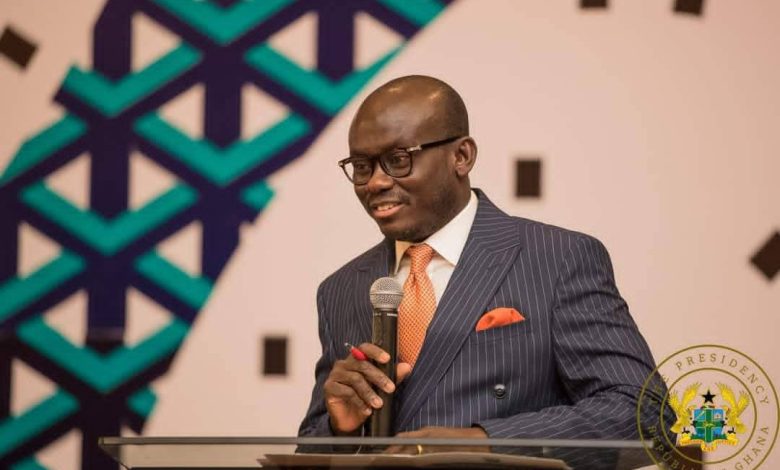
Immediate past Attorney-General says the appeal that overturned Sedina Attionu’s conviction was handled after he left office, accusing the current administration of distorting the facts.
Former Attorney-General and Minister for Justice, Godfred Yeboah Dame has strongly denied claims that his tenure contributed to the acquittal and discharge of former Chief Executive Officer of the Microfinance and Small Loans Centre (MASLOC), Sedina Tamakloe Attionu, insisting the judicial developments that culminated in the Court of Appeal’s decision occurred after he had left office.
In a statement issued through Dame & Partners on Friday July 31, 2026, the former Attorney-General dismissed allegations that the previous Akufo-Addo administration mishandled Attionu’s appeal, describing the accusations as a false narrative being advanced by communicators of the governing National Democratic Congress (NDC) to shift responsibility from the current government. Dame argued that records surrounding the case clearly demonstrate that neither he nor the Attorney-General’s Department under his leadership was responsible for the circumstances that led to the Court of Appeal overturning Attionu’s conviction.
According to him, no notice of appeal allegedly filed by Attionu in 2024 was ever served on the Attorney-General’s Department while he was in office. He said state prosecutors informed the Court of Appeal, both orally and through written submissions in April 2026, that they had never received any appeal notice and only became aware of the proceedings after the court directed all parties to file written arguments. He further maintained that even if an appeal had technically been filed in 2024, it remained inactive throughout his tenure because neither Attionu nor her legal representatives took any further procedural steps until after the change in government.
Dame said his administration’s priority during that period was pursuing Attionu’s extradition to Ghana to serve the sentence imposed following her conviction. He noted that those efforts culminated in a ruling by a United States District Court in Nevada on April 9, 2026, which upheld Ghana’s extradition request and ordered that Attionu remain in custody pending a final extradition decision by the U.S. Secretary of State. He stressed that throughout the extradition proceedings, which spanned from July 2024 to April 2026, neither Attionu nor her lawyers informed the American court of any pending appeal in Ghana, arguing that this further undermined claims that the appeal had been actively pursued during his administration.
The former Attorney-General outlined what he described as the actual sequence of events in the appeal process, stating that Attionu’s lawyers only sought and obtained permission from the Court of Appeal to file written submissions on February 10, 2026, before submitting them two days later. According to him, state prosecutors were only served with those submissions on February 16, 2026, despite having had no prior notice of the appeal. He said the prosecution nevertheless prepared a response and obtained leave from the court on April 9, 2026, to file opposing submissions.
Dame explained that the Principal State Attorney subsequently raised concerns over defects in the appeal record, including the omission of key trial exhibits, while reiterating that the prosecution had only become aware of the appeal after the court’s directive. He said the Court of Appeal, then chaired by Justice Mensah Datsa, later ordered that three volumes of the appeal record be made available to the Republic. Following a review of those records, the prosecution successfully applied to include three additional documents in the appeal record on May 28, 2026, before the matter was adjourned to June 17.
He further pointed out that the appeal was subsequently heard by a differently constituted panel of the Court of Appeal led by Justice Ankamah, which heard arguments and reserved judgment after he had already left office as Attorney-General. While acknowledging widespread public concern over Attionu’s acquittal, Dame argued that the verdict had generated disappointment because of what he described as the substantial evidence presented during the original criminal trial.
He also used the statement to criticise the current administration of pursuing selective justice by discontinuing criminal prosecutions involving persons associated with the governing NDC while aggressively pursuing corruption-related cases against political opponents under the government’s anti-corruption drive known as “Operation ORAL.” Drawing comparisons with the long-running Woyome case, Dame alleged that the Attionu matter reflected unequal application of the law based on political affiliation and called on Ghanaians to hold the government accountable for what he described as a growing pattern of politically selective prosecutions.
He warned that public confidence in Ghana’s justice system would continue to erode if legal processes were perceived to favour political allies while being applied more rigorously against opponents.
By: Joyce Owusu