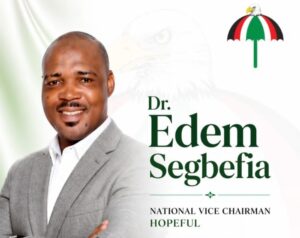

Dr. Edem Segbefia, an aspirant for the National Vice Chairmanship of the National Democratic Congress, has described the Mahama administration’s programme of works, housing and water reforms as a decisive reorientation of Ghana’s public infrastructure. Addressing party grassroots cadres in the Bono Region, Segbefia characterised the interventions as a concerted endeavour to resuscitate moribund projects, broaden access to affordable accommodation and guarantee potable water for communities hitherto marginalised. He averred that governance had transitioned from proclamation to execution, with tangible delivery now underpinning the NDC’s stewardship.
According to Dr. Segbefia, the administration’s stated remit of “Build Ghana, House Ghanaians, Water for All” has galvanised the recommencement of abandoned roadworks and the inauguration of new schemes nationwide. Contractors have resumed activity on principal trunk, urban and feeder roads following the settlement of outstanding obligations, with precedence accorded to arteries linking agrarian communities to markets to mitigate post-harvest wastage and attenuate haulage expenditure. Bridges and culverts in inundation-prone districts are undergoing rehabilitation ahead of the rains to preclude the isolation of settlements. Concomitantly, dormant state housing estates are being appraised for completion, while strategic alliances with private developers and mortgage institutions are being cultivated to furnish low-cost dwellings on flexible tenures for public servants and young professionals.
In the water domain, the government has accelerated the deployment of boreholes, small-town reticulation systems and mechanised schemes, with pronounced emphasis on the Northern Savannah and Upper East enclaves. Urban supply in Bolgatanga, Bawku and Nalerigu is being fortified through network augmentation to ameliorate intermittent service. Beyond provision, Segbefia noted, there is more stringent oversight of effluent discharge into rivers and dams, together with capital outlay for new dams, dugouts and canals to underwrite dry-season cultivation and insulate farmers from climatic variability. Metropolitan and municipal assemblies are desilting existing drains and constructing additional conduits in vulnerable localities, while the ministries responsible for Works, Housing and Water Resources are coordinating with NADMO to attenuate seasonal flood risk.
Segbefia posited that the dividend of such interventions was both material and political. “When a road connects a farmer to market, when a tap gives a mother clean water, when a youth gets a job on site – that is NDC changing lives,” he observed. He enjoined constituency executives to compile registers of local artisans, masons, drivers and suppliers for onward transmission to district works departments, to ensure host communities derive primary benefit from project employment. He further urged branches to mobilise members for affordable housing registration, to convene commissioning durbars upon completion of roads and water points, and to chronicle transformations for dissemination at the grassroots. “Before NDC, abandoned roads, dry taps, no houses. Under Mahama, roads working, water flowing, houses coming,” he declared.
The current impetus follows an epoch of attrition in public works. Prior to January 2025, a considerable proportion of the populace contended with impassable farm-to-market routes, an acute housing shortfall and erratic water supply. According to obky news report, the renewed emphasis seeks to redress that deficit by embedding development within quotidian experience. By privileging roads, housing and water, the administration is alleviating transport costs, diminishing the burden of water-borne morbidity and generating livelihoods through direct labour and indigenous procurement.
Looking forward, Segbefia underscored the imperative of vigilance to safeguard facilities from depredation and to ensure equitable apportionment. With infrastructure now constituting a defining pillar of the NDC’s governance architecture, he contended that the party’s electoral viability would hinge upon sustaining delivery that citizens encounter in their thoroughfares, domiciles and communities.
Call or WhatsApp +233 20 2190 250 and share your story.
Author: Korkor Anumu