Blackouts: Akosombo System Set for Fix- Jinapor
The Energy Minister says completing the remaining works at Akosombo will restore the grid’s original configuration and strengthen power supply reliability.
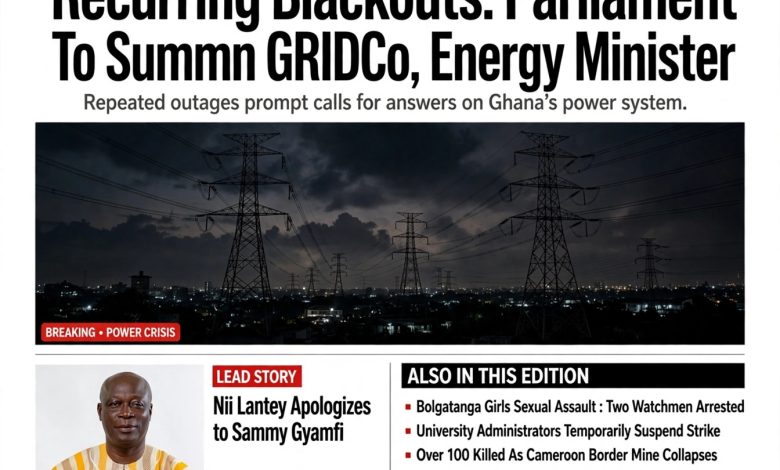
The remaining works to restore the original power transmission arrangement at the Akosombo Power Station are expected to be completed next month, Energy and Green Transition Minister Dr John Abdulai Jinapor has said. The restoration is expected to end the temporary transmission arrangement currently being used to evacuate power from Akosombo to Tema, which the Minister has identified as the underlying factor in two major power system disturbances recorded in August.
Dr Jinapor disclosed this while speaking on Joy News after the latest widespread power disruption on Thursday, August 20, 2026, which affected parts of the country. The Ghana Grid Company Limited (GRIDCo) said the incident resulted from a trip on power transmission lines. The latest disruption is the second major system disturbance recorded this month, intensifying concerns over the resilience of Ghana’s electricity transmission network. According to Dr Jinapor, the difficulties stem from a fire incident at the Akosombo switchyard that damaged the control centre and forced engineers to adopt an alternative arrangement to keep electricity flowing from the hydroelectric facility.
He said authorities initially faced the difficult choice of shutting down the Akosombo Power Station until the original control system could be restored—a process that could have taken about six months—or finding a temporary solution to keep the facility operating. “Ordinarily, we shouldn’t have blackouts more than two in a year. We have a peculiar situation we are dealing with. You recall the fire incident at Akosombo. When I visited them, we had two options,” he said.
Some engineers, he explained, favoured keeping the plant offline until the control centre had been fully restored, while others proposed a temporary arrangement involving relays to transmit electricity directly from Akosombo to Tema, with the thermal control room providing support to the system. Dr Jinapor said the government opted for the temporary solution because shutting down Akosombo for an extended period would have placed considerable pressure on the country’s electricity supply. “I thought that shutting down Akosombo for six months was untenable, so we opted for the temporal arrangement,” he said.
However, he acknowledged that the alternative system was less robust than the original configuration and carried vulnerabilities. “That arrangement is not very robust, but given the circumstance that we find ourselves, we thought that even with the fragility, that was the best option,” the Minister said. He further linked both major system disturbances recorded in August to the temporary arrangement. “So the two major incidents we’ve had, all of them traces back to the temporal arrangement,” he stated.
Despite the challenges, Dr Jinapor said work to restore the original system is progressing steadily. Of the six major components required for the restoration, four have already been completed, leaving two outstanding. “But fortunately, we’ve already done four. We are left with two, and my briefing is that next month the other two will be completed,” he said. The completion of the remaining components is expected to allow engineers to return the Akosombo transmission system to its original configuration and improve the overall stability and resilience of the national grid. “When that is completed, then we would refer to the original arrangement and use that system,” Dr Jinapor added.
The government’s decision to maintain power generation at Akosombo while restoration works continue has enabled the country to avoid the potentially significant supply consequences of taking one of Ghana’s key generation facilities offline for several months. The Minister’s assurance comes amid renewed public concern over recurring power interruptions and the reliability of the national transmission system. With the restoration works expected to be completed next month, attention will now turn to whether the return to the original Akosombo configuration can reduce the frequency and severity of major system disturbances.
By: Joyce Owusu