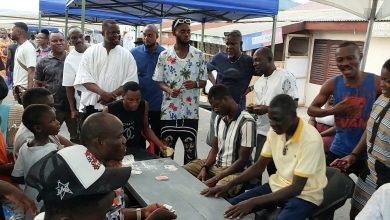
Jagga Pee wants pension scheme for veteran actors
Veteran actor Jagga Pee is urging President Mahama to create a welfare fund for ageing performers facing life after the spotlight.

Veteran actor Abeiku Nyame, popularly known as Jagga Pee, has appealed to President John Dramani Mahama to establish a dedicated welfare fund for veteran actors and actresses who have spent decades entertaining Ghanaians but often have little financial security when acting opportunities decline. Jagga Pee said the absence of a structured pension or welfare system for performers leaves many ageing actors vulnerable after years of contributing to Ghana’s creative industry. He made the appeal in an interview with Graphic Showbiz on Tuesday, August 18, stressing that unlike workers in the formal sector, actors generally do not retire with a dependable pension to support them when they can no longer secure regular roles. “I’ll plead with him to establish a welfare fund for veteran actors and actresses because you know, this work, we don’t come on pension,” he said.
According to Jagga Pee, the situation has become increasingly difficult for veteran performers as the number of opportunities available to them continues to shrink. He identified what he described as a growing practice in the film industry of casting younger actors to portray elderly characters as one of the factors affecting veteran actors. He said some young performers are made to look older through makeup, hairstyles and costumes, allowing producers to fill roles that could otherwise provide employment for experienced veteran actors. “The most unfortunate is that these days, they dress young men like old people. They paint their hair white and push them to play old people’s roles. That has contributed to our woes and pushed some of us out of business,” he said.
Jagga Pee was keen to stress that his appeal was not politically motivated. He said President Mahama had demonstrated a longstanding interest in the welfare of people in the creative sector, including at a time when he was not President. He recalled instances in which the President had personally supported entertainers and pointed specifically to the assistance shown to veteran actor Super OD. For Jagga Pee, such gestures demonstrate goodwill towards the arts community, but he believes individual interventions should be transformed into a permanent system capable of supporting veteran performers more broadly.
He recounted his own experience during a period of hospitalization, saying President Mahama arranged for his wife to visit him. After recovering, Jagga Pee said he personally visited the President to express his appreciation and was moved by the way Mr Mahama spoke about his contribution to the entertainment industry. He recalled the President describing him to people around him as “the man who made us laugh.” For Jagga Pee, the memory illustrates the value that veteran entertainers have brought to Ghanaian society and why their welfare should be treated as a national concern.
The veteran actor also challenged the perception that actors are automatically financially comfortable because they are public figures. He said actors negotiate their fees, but the final amount is often determined by producers, leaving performers with limited bargaining power. “Actors aren’t rich like the producers because when you charge them, they say, ‘Oh, it’s too much, it’s too much.’ No matter what, they will give you what they want,” he said. He further alleged that some producers have become reluctant to engage veteran actors because of assumptions that their fees are too high. That, he said, has further reduced the opportunities available to performers who have accumulated years of experience in the industry.
The situation, in his view, exposes a broader weakness in Ghana’s creative economy: the industry benefits from performers during their most productive years but has few mechanisms to protect them when their earning capacity declines. Jagga Pee also rejected claims that Ghana’s film industry is completely dead, but acknowledged that it has contracted significantly. “It’s not dead, but it’s shrinking,” he said. He attributed the decline partly to poor audience turnout and said only a small number of producers remain consistently active, while many others are struggling to finance and release films. He also compared the earnings of Ghanaian actors with those of their Nigerian counterparts, arguing that actors in Nigeria generally receive better financial rewards and, in some cases, are paid in foreign currency.
His comments point to the wider economic challenges confronting Ghana’s film sector, where reduced production, changing audience habits and limited financing have affected employment opportunities for actors and other industry professionals. For veteran performers, however, the consequences go beyond the decline of film production. As acting opportunities disappear with age, many are left without a reliable source of income or institutional support despite decades of work that helped shape Ghana’s entertainment culture. Jagga Pee’s proposal for a welfare fund therefore seeks to place the long-term wellbeing of veteran actors on the national policy agenda.
Such a system, if established, could provide a more structured form of support for performers who have reached an age or stage in their careers where securing regular acting roles becomes increasingly difficult. His appeal ultimately raises a broader question about how Ghana rewards and protects the people who have built its creative industries—and whether decades spent entertaining the public should end with performers having to struggle for basic financial security after the cameras stop rolling. Or should the actors possibly make personal arrangements for their retirement in the absence of a national fund while the cameras still roll?
By: Joyce Owusu