
Floating Voters Could Decide 2028 Race – Musah Dankwa
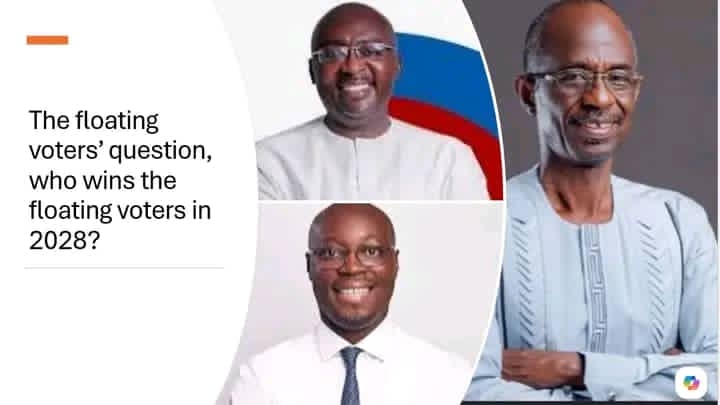
New polling suggests the battle for Ghana’s growing bloc of floating voters may ultimately determine who wins the 2028 presidential election.
Musah Dankwa, Executive Director of Global Info Analytics, has indicated that Ghana’s rapidly expanding bloc of floating voters could emerge as the decisive force in the 2028 presidential election, with new polling suggesting significant differences in how the leading contenders perform among the critical voting group. According to the latest survey analysis by Global Info Analytics, floating voters now account for approximately 18 percent of the electorate, a figure that continues to grow. Dankwa argues that beyond securing traditional party strongholds, the eventual presidential candidates will need to retain their respective 2024 voter bases while making substantial gains among the estimated two million eligible voters who did not participate in the last general election.
The poll compared hypothetical match-ups involving the New Patriotic Party’s 2024 presidential candidate, Dr. Mahamudu Bawumia, against two leading figures expected to feature prominently in the National Democratic Congress’ presidential race, Johnson Asiedu Nketia and Dr. Cassiel Ato Forson. Overall, the survey shows Asiedu Nketia leading Dr. Bawumia by 11 percentage points among floating voters, while Ato Forson records a wider 24-point advantage over the former Vice-President in a direct match-up. However, Dankwa noted that a deeper analysis of the voting history of floating voters paints a more revealing picture.
In a hypothetical three-way contest involving Asiedu Nketia, Dr. Bawumia and Kennedy Agyapong, the survey found that Asiedu Nketia attracts seven percent of floating voters who supported Dr. Bawumia in the 2024 election, while Kennedy Agyapong secures 12 percent, leaving Dr. Bawumia retaining 77 percent of his floating voter base. Among floating voters who backed former President John Dramani Mahama in 2024, the results indicate that Asiedu Nketia retains only 62 percent. The poll suggests 17 percent would switch to Dr. Bawumia, while another 10 percent would move to Kennedy Agyapong, a performance Dankwa described as particularly weak for the NDC.
The contest is even tighter among floating voters who abstained from the 2024 elections. According to the survey, Asiedu Nketia polls 30 percent, narrowly trailing Dr. Bawumia on 31 percent, while Kennedy Agyapong records 25 percent. Dankwa observed that should Kennedy Agyapong decide not to contest, a significant share of those votes would become available to the remaining candidates. The dynamics shift considerably in favour of Ato Forson, the poll indicates.
Among floating voters who supported Dr. Bawumia in 2024, Ato Forson secures 12 percent, matching Kennedy Agyapong’s share, while Dr. Bawumia retains 73 percent. Within the bloc of floating voters who voted for John Mahama in 2024, Ato Forson retains 74 percent of the vote, while Dr. Bawumia attracts 13 percent and Kennedy Agyapong secures 7 percent. The most significant difference emerges among voters who stayed away from the polls in 2024. The survey places Ato Forson well ahead with 44 percent support, compared with Dr. Bawumia’s 25 percent and Kennedy Agyapong’s 21 percent, suggesting the Finance Minister performs substantially better among previously inactive voters.
Comparing the two NDC contenders, Dankwa said the data indicates Asiedu Nketia trails Ato Forson across the key floating voter categories. According to the analysis, Asiedu Nketia performs four percentage points worse among floating voters who backed Dr. Bawumia in 2024, loses 13 percentage points more of John Mahama’s 2024 floating voter support, and underperforms Ato Forson by 14 percentage points among floating voters who did not vote in the last election. He added that, based on the current polling, Asiedu Nketia faces the greatest challenge in expanding his appeal among floating voters and would need to significantly improve his performance within that increasingly influential segment of the electorate before the 2028 presidential race.
Dankwa concluded that the findings underscore the strategic importance of floating voters ahead of the 2028 election, arguing that while all major contenders face significant electoral hurdles, success may ultimately depend on their ability to consolidate existing support while winning over undecided and previously inactive voters.
By: Joyce Owusu


